
AI cost is usually measured after the work is complete. By then, the models have been called, the agents have acted, the tools have run, and the resources have been consumed.
The invoice can show what was charged. It cannot always explain what the enterprise was trying to accomplish, why a particular execution path was taken, or whether the resulting outcome justified the cost.
Those questions belong to a broader discipline: AI execution economics.
AI execution economics is the relationship between the resources consumed by AI-enabled work, the path the work takes, and the outcome it produces.
The economics emerge during execution
A request may appear simple to the person making it. Underneath, it can initiate a changing chain of activity.
A model may interpret the objective. An agent may develop a plan. Other models, applications, data sources, and tools may contribute. Outputs may be validated, rejected, retried, or escalated for human judgment.
Each decision changes the economics of the work.

One objective can generate activity across multiple models, agents, tools, and controls before reaching an outcome.
This is why the cost of AI cannot be understood solely from an individual token, model call, or provider invoice. The meaningful unit is the execution: the complete path from enterprise intent to enterprise outcome.
The scale of the issue is becoming visible. A 2026 McKinsey survey of 75 qualified enterprise respondents found that 93 percent had exceeded their AI budgets. Its analysis also found that token consumption for the same task can vary by as much as 30 times (McKinsey's enterprise AI cost analysis).
But unpredictable consumption is only part of the problem. The larger issue is that cost often becomes visible without the execution context needed to interpret or control it.
Cost without context is incomplete
Knowing that a model consumed a certain number of tokens answers a billing question. It does not answer the enterprise questions surrounding the work:
- What objective created the cost?
- Which models, agents, applications, and tools contributed?
- Why did the execution follow that path?
- Did retries, failures, or escalation increase consumption?
- What outcome was produced?
- Could the enterprise have intervened before the cost accumulated?
Without that context, cost remains observable but not fully accountable.
Good economics does not mean choosing the cheapest path
AI execution economics is not simply an effort to reduce consumption.
The least expensive model may not produce the required quality. A faster path may introduce unacceptable risk. Additional validation may increase cost while being necessary for a consequential decision. Human review may be more expensive and still be the correct next step.
The economic question is therefore not:
What is the cheapest way to complete this task?
It is:
Which valid execution path creates the appropriate balance of cost, quality, speed, risk, and expected value?
That decision can change while work is underway. New context may appear. Validation may fail. An agent may enter a loop. A preferred model may become unavailable. The value or consequence of the outcome may increase.
Execution economics must be able to change with it.
From economic measurement to economic control
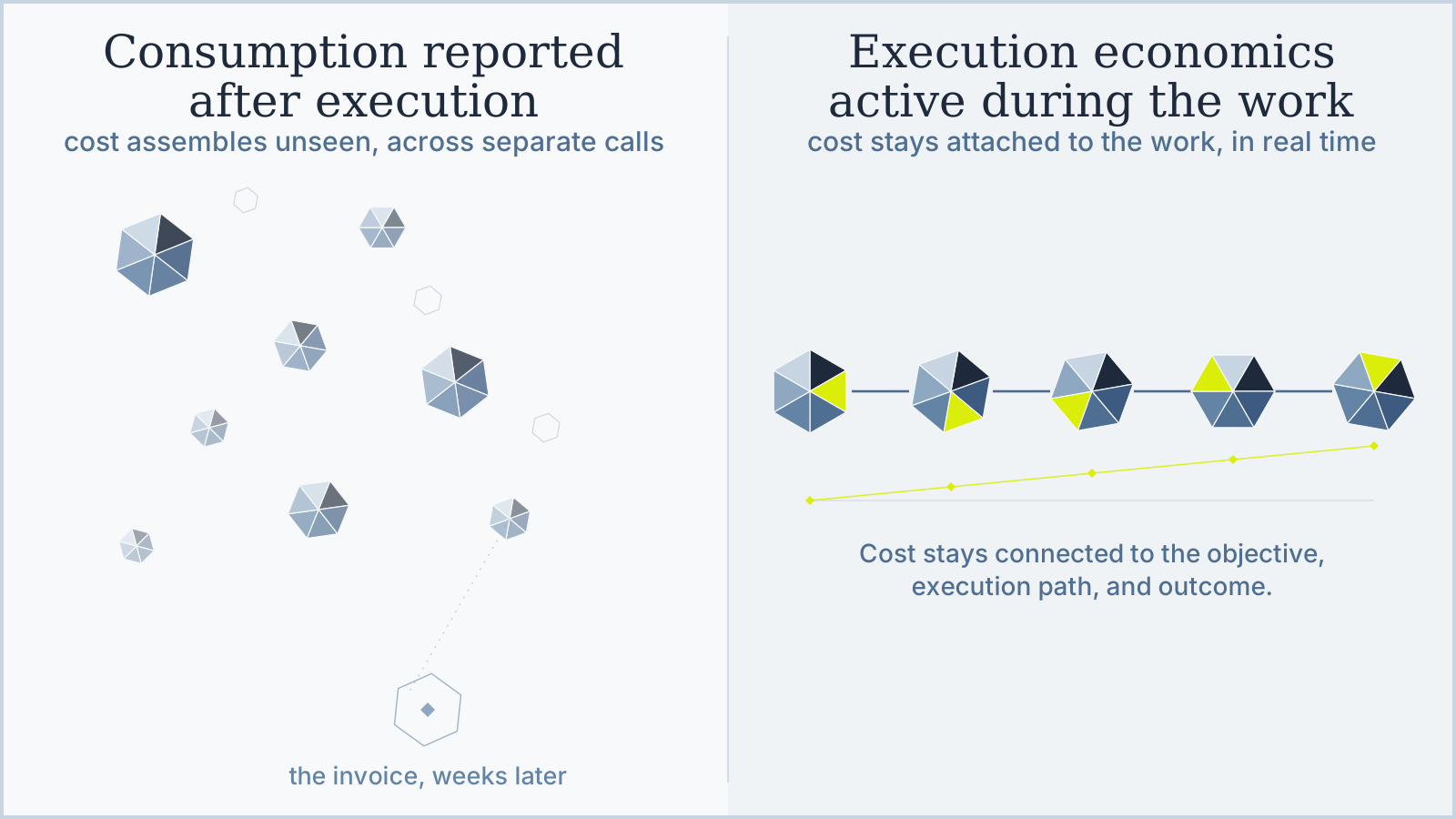
Traditional cost reporting explains consumption after it occurs. AI execution economics makes economic information available while decisions can still be affected.
That can allow an enterprise to:
- Attribute cost to an objective rather than only to a provider
- Track accumulating consumption across the full execution
- Identify retries, loops, and unnecessary escalation
- Consider cost when choosing among otherwise valid paths
- Apply thresholds based on the value or consequence of the work
- Pause, redirect, or escalate before consumption compounds
- Preserve evidence explaining why a particular path was selected
Cost becomes an execution signal: important enough to influence what happens next, but never permitted to override authority, policy, validation, or safety.
AI execution economics within BuffAIt
BuffAIt™ makes economic context part of governed AI execution.
As work moves across models, agents, applications, data, and human decision points, cost remains connected to the objective and the evolving execution. It can inform routing, thresholds, escalation, and intervention alongside authority, policy, validation, safety, and evidence.
This creates a more complete record of the work: not merely what was consumed, but what the enterprise was trying to achieve, how the execution unfolded, what outcome was produced, and why the chosen path was economically justified.
Before the invoice arrives
The invoice still matters. It supports payment, reconciliation, budgeting, and financial reporting.
It simply arrives too late to govern the execution that created it.
AI execution economics moves the economic decision point into the work itself, while the enterprise can still decide whether execution should proceed, change, pause, escalate, or stop.
That is the difference between knowing what AI cost and governing its economics.