
For years, most enterprise conversations about AI have centered on what the technology can produce. Can it summarize a long document accurately? Find the right information? Draft something useful? Make a good recommendation? Those are still important questions, but they no longer describe the full role AI is beginning to play inside organizations.
Increasingly, AI output is becoming part of how work moves forward. An AI system might interpret a request, gather information from several sources, weigh alternatives, select another capability to involve, prepare a result for action, or influence what happens next in a business process. It may do all of this within defined permissions, inside an approved environment, with people still responsible for important decisions.
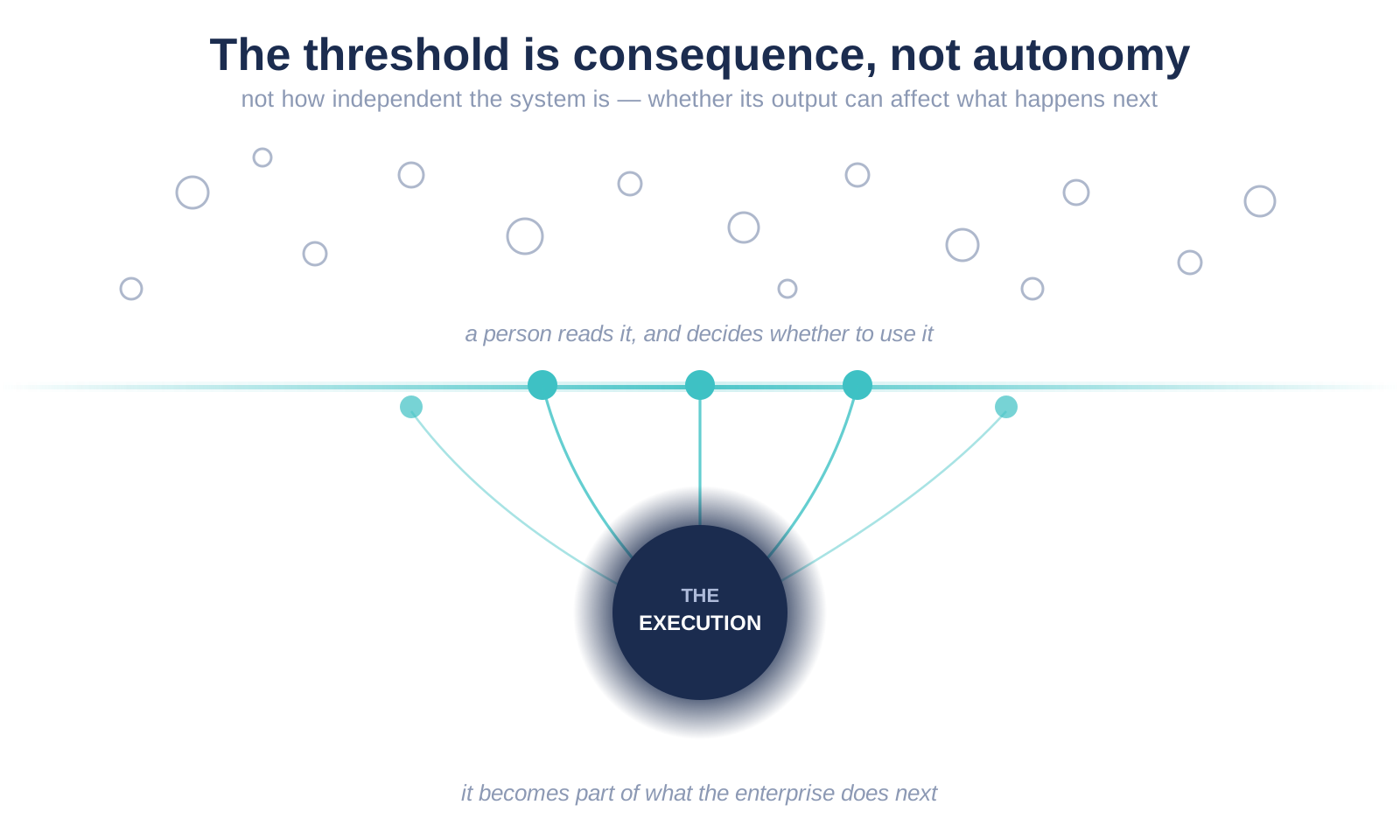
That is where the governance problem begins to change. The important threshold is not whether AI has become fully autonomous. It is whether what AI produces can begin to affect what the enterprise does next.
And even as AI takes on a larger role in carrying out the work, responsibility for the outcome still belongs to the enterprise. A model does not become accountable for a business decision because its recommendation influenced it. An agent does not assume responsibility for a transaction because it helped execute it. The enterprise may delegate more of the work to AI, but it does not delegate away its accountability for what that work produces.
The Threshold Is Consequence, Not Autonomy
It is easy to understand why autonomous agents get so much attention. A system that can plan work, choose tools, take actions, and pursue an objective on its own raises obvious questions about control. But enterprises do not have to wait for that level of autonomy before those questions become relevant.
AI can have a meaningful effect on execution while remaining quite constrained. A system may interpret an incoming request without being allowed to approve it. It may analyze records and identify what deserves attention while leaving the final decision to a person. It may prepare work that another system carries forward or choose among capabilities the enterprise has already approved.
The AI is still operating within boundaries. Yet subsequent work may depend on what it interpreted, selected, generated, or caused another system to do. Once that happens, the AI is no longer simply producing information for someone else to consider. Its output has become part of the progression of the work.
Human involvement does not erase that distinction. A person may still make the final decision, but AI may already have shaped the information that reached them, the alternatives considered, the analysis performed, or the path the work took before the decision arrived. An AI system can also operate entirely within approved access and still influence a result with business consequences.
This is why autonomy is not the most useful dividing line. The more durable question is whether AI can affect what happens next.
AI Adds a Different Kind of Judgment to Enterprise Work
There is an important question underneath that argument: haven't enterprises been letting software move work forward for decades? Of course they have. Business applications enforce rules. Workflow platforms route tasks. Automation systems invoke services and move data. Rules engines evaluate conditions and make decisions. Enterprises already know how to build software that affects execution, and AI does not make those systems obsolete.
The difference is in the kind of judgment AI introduces.
Traditional workflows and rules-based automation are generally built around conditions and responses specified in advance. If a required field is missing, stop. If an amount exceeds a threshold, use a different approval path. If a user lacks the required access, deny the request. The rules may be highly sophisticated, but the enterprise generally knows what condition is being evaluated and what response it is supposed to produce.
Many AI systems are probabilistic. They can interpret unstructured information, infer meaning, compare imperfect alternatives, identify patterns, generate intermediate work products, and reach conclusions that were not explicitly programmed in advance. The exact result can vary with the information available, the surrounding context, the model involved, and the probabilistic nature of the systems themselves.
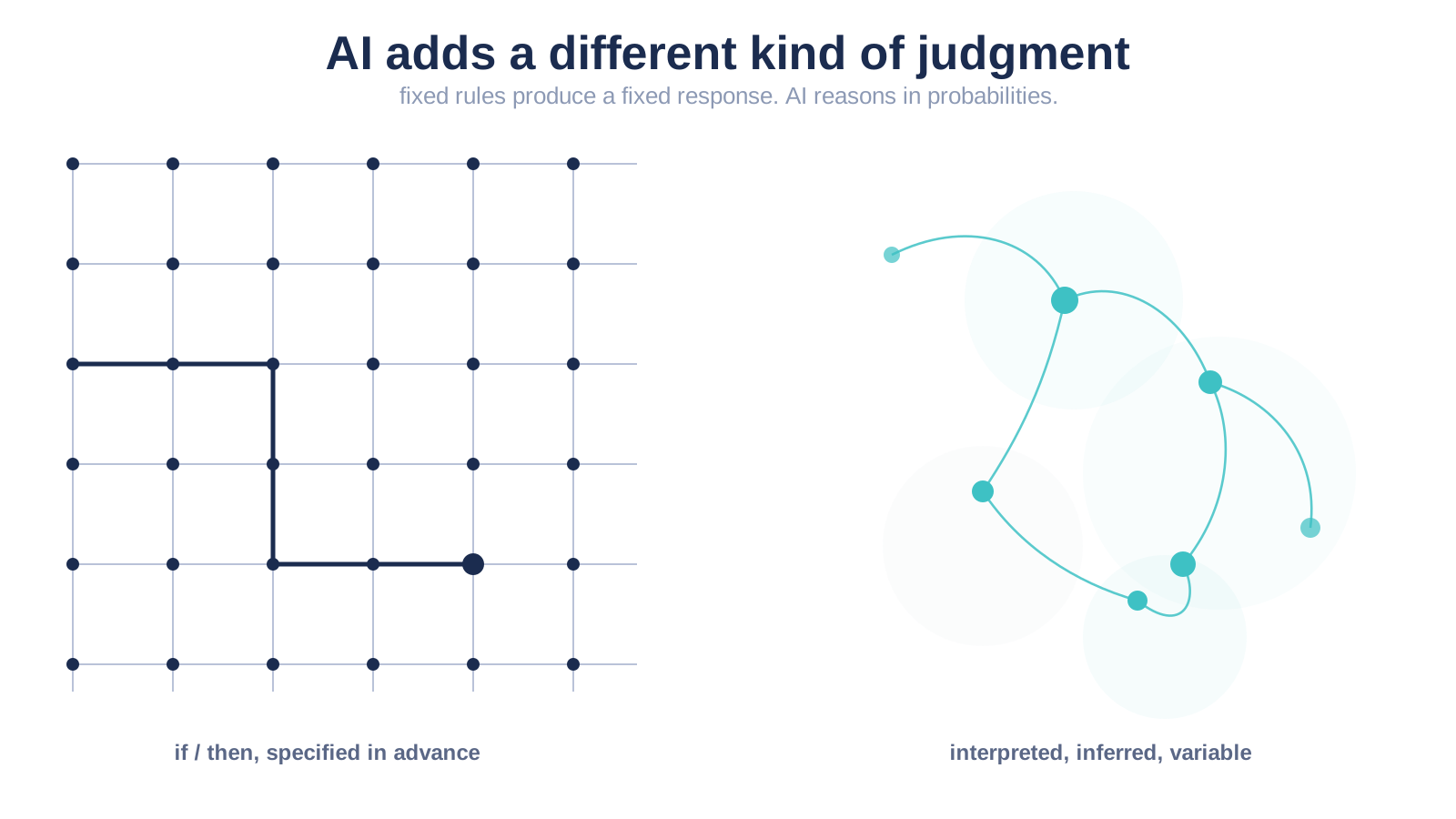
That variability is not necessarily a flaw. It is part of what makes AI useful for work that cannot easily be reduced to predefined rules. But it changes what the enterprise can safely assume about execution.
With conventional workflow logic, successful completion of a step generally means the system performed the operation it was designed to perform. With AI, producing an answer is not necessarily the same as producing an answer that should be allowed to influence the next action. A result can be useful without being sufficient. It can be plausible without satisfying a business requirement. It can be technically sound while the circumstances surrounding the work make a different response necessary.
The enterprise does not need AI to become perfectly predictable. It needs dependable control over what happens when AI-generated judgment becomes part of execution.
Governing the AI Is Not the Same as Governing the Work
Enterprises are not starting from zero. They already have substantial control environments around identity, security, data, applications, business policy, approvals, audit, and increasingly AI itself.
Those responsibilities are distributed for good reasons. Identity systems should establish and enforce identity and access decisions within their domain. A security platform should make security determinations. A business application should enforce the rules that belong to its domain. People with delegated authority should continue to make decisions the organization has assigned to them.
AI does not eliminate any of that. As AI becomes more involved in enterprise execution, those existing authorities matter more, not less.
The difficulty is that a business objective can move across several of them. One piece of work may begin with an authenticated employee, use information from multiple systems, involve one or more AI capabilities, pass through security or data controls, enter a business application, and eventually require a human decision. Each participant may perform its own role correctly.
And yet the enterprise can still face a broader question: is the work, as it exists now, still allowed to proceed in the way it is currently proceeding?
That question does not necessarily belong to any one participating system. The identity platform sees identity. The security system sees security conditions. The business application understands its own transaction rules. The AI system sees the task it has been asked to perform. A person may hold authority over a particular decision.
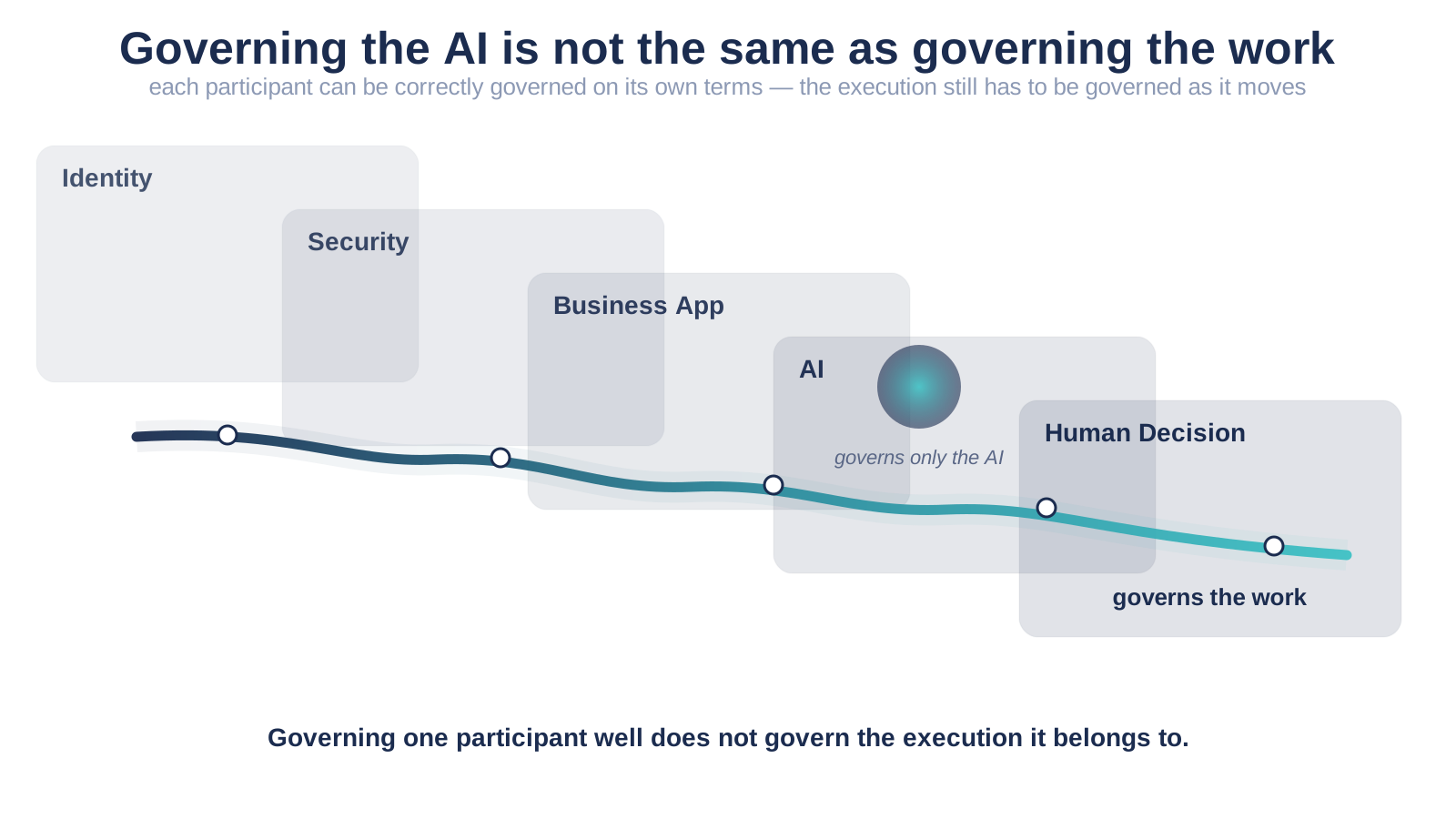
The work, however, keeps moving among them. Governing each participant is therefore not always the same as governing the execution they collectively carry forward.
The Environment Will Not Hold Still
The challenge becomes more significant because the enterprise AI environment itself is changing rapidly.
AI is no longer confined to a few dedicated projects. Enterprise software vendors are embedding it into products companies already use. Business platforms are adding assistants, copilots, agents, and automated decision functions. Internal teams are building specialized agents. External AI services and models can be introduced when they are useful for a particular task.
The result is not one stable AI environment that an enterprise can govern once and leave in place. The systems performing a particular task can change over time, and different parts of the organization may use different combinations of technology to pursue similar objectives.
That makes governance harder when it depends too heavily on the particular technology involved. A control approach that has to be redesigned whenever a new model, agent, application, or platform enters the environment will struggle to keep pace.
The enterprise needs to accommodate that change without allowing the governing conditions around the work to disappear with it. Authority should not vanish because a different agent performs a task. Policy should not stop applying because a platform adds a new AI function. Validation should not depend on one permanent model provider.
The technology can change. The enterprise's responsibility for the execution does not.
The Work Changes While It Is Underway
The environment changes over time, but an individual execution can change while it is happening as well.
Most business processes begin with assumptions that appear reasonable. The requester is authenticated. The systems involved are approved. Access has been granted. Relevant policies have been applied. The work appears ready to proceed.
Those conditions describe the beginning of an execution, not necessarily everything that will become relevant before it ends.
New information can appear. An AI result can change what needs to happen next. A different system can introduce a restriction. The destination of a result can matter in a way the source did not. A human decision can alter the path.
None of those events means the original controls were wrong. The work may simply have changed.
That matters because authority and policy are often contextual. Someone can be authorized to initiate work without being authorized for every decision the work may eventually require. Information can be appropriate for one purpose and inappropriate for another. A result can satisfy one requirement while still failing another condition that matters before it affects a downstream action.
The enterprise therefore cannot assume that a control decision made at the beginning will remain sufficient simply because the work is still pursuing the same objective. Governance has to remain relevant as the execution develops.
This does not mean putting an approval in front of every AI action or creating one giant control system that absorbs the enterprise's existing authorities. The goal is not to centralize every decision. It is to make sure the decisions that already matter can continue to matter when they become relevant to the work.
The Execution Is the Common Thread
A useful way to think about the problem is to follow the execution itself.
An execution is the evolving body of work through which the enterprise is pursuing an objective. It may include AI interactions, system actions, control decisions, changes in path, and human judgment. Individual participants may be involved only briefly, while the business objective continues across them.
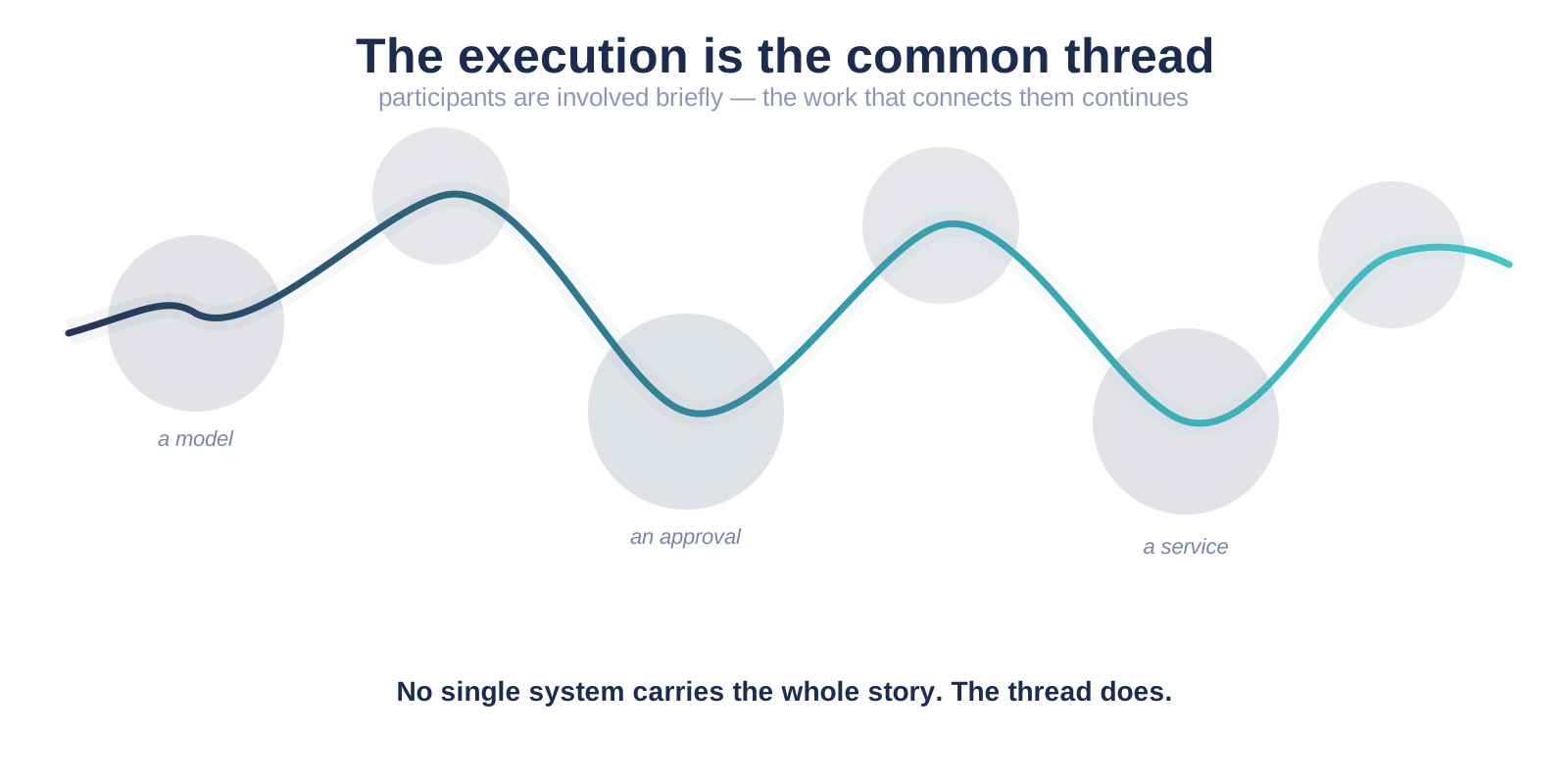
As the work progresses, the enterprise still needs to know who or what is acting, what authority applies, which policies matter, whether a result is suitable to advance, when human judgment is required, and what evidence explains why the work was permitted to proceed as it did.
No individual model, agent, application, or control system needs to answer all of those questions. In most enterprises, it would be inappropriate for any one of them to do so. Different systems and people hold different authorities because those responsibilities should remain distributed.
The challenge is keeping their decisions connected closely enough to the same evolving work that they remain consequential.
That is the shift. When AI primarily produced information for people to consider, governance could reasonably focus on the AI system itself: what it could access, how well it performed, what risks it introduced, and how people used its output.
When AI begins participating in the progression of work, the enterprise inherits another question: can we keep the work governed as it changes?
The Governance Problem Has Changed
Not every use of AI creates this problem. If an AI system drafts a paragraph, summarizes a report, or produces an idea that someone reads and decides whether to use, the enterprise may be well served by the controls it already has around the system, the information, and the person using it.
The governance problem changes as AI becomes more tightly connected to execution and its outputs begin carrying consequences into subsequent work. At that point, it becomes harder to think about AI governance only in terms of the behavior of an individual system.
The enterprise has to account for work that may cross technical and organizational boundaries, incorporate probabilistic AI-generated judgment, and change as new information appears. Through all of that, accountability for the business outcome remains with the enterprise.
So the question is no longer only "Is this AI system governed appropriately?" It is also: can the enterprise keep the execution governed while AI participates in it?
The next question is architectural. If work can move across AI systems, applications, tools, enterprise controls, and human decisions while the conditions governing that work continue to evolve, coordinating those participants is not enough. The enterprise also has to determine what is allowed to happen next. That is where orchestration and control begin to separate.