
In the first article in this series, we looked at a shift that is easy to underestimate. AI does not have to become fully autonomous before it changes the enterprise governance problem. Once AI-generated judgment begins affecting what happens next, AI has become part of the execution itself.
That raises the next question: how does an enterprise maintain control when the work can move across AI systems, applications, tools, enterprise controls, and human decisions while it is underway?
At first, orchestration seems like the natural answer. If work involves many participants, something has to coordinate them — deciding which model, agent, service, or application performs a task, where information goes next, what happens when a result comes back, and how the pieces fit together. All of that is necessary, but it is not the same thing as control.
An orchestration platform may contain controls of its own. The distinction is one of scope: those controls typically govern the workflow being orchestrated, while governed execution must keep relevant authority and conditions active across systems and control domains.
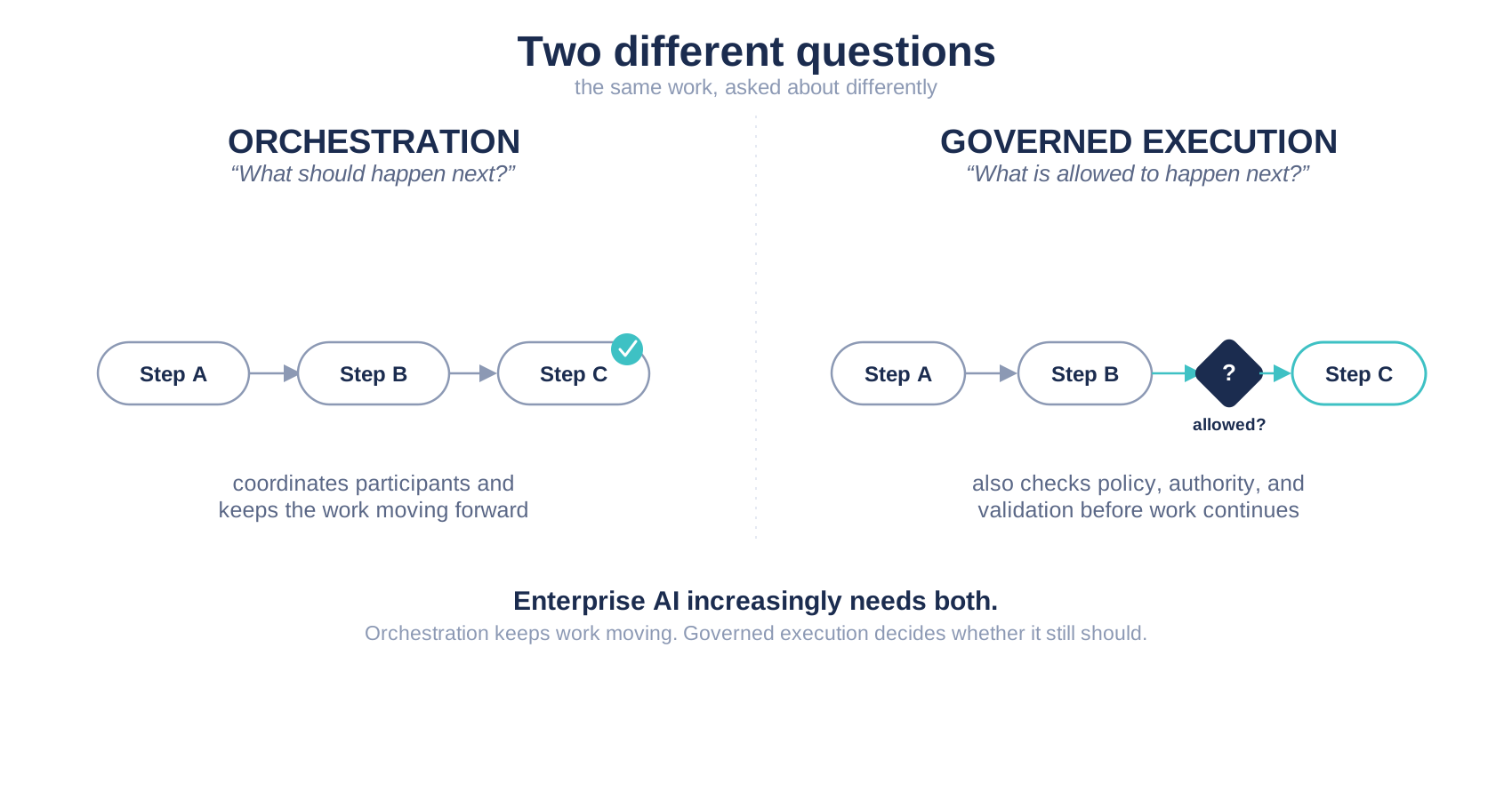
Orchestration’s primary responsibility is coordinating how work moves forward. Governed execution has to answer another question alongside it: given what we know now, is the work still permitted to move forward in this way?
That distinction becomes increasingly important as AI moves deeper into enterprise execution.
Orchestration Answers a Different Question
A single business objective may require several participants. One system retrieves information. Another analyzes it. An agent invokes a tool. A business application performs a transaction. A person makes a decision somewhere along the way. Something has to coordinate that activity.
An orchestrator can determine which participant should perform the next task, pass information between systems, manage dependencies, handle retries, and keep the work moving toward completion. As AI environments become more complex, those functions become more valuable, not less.
But orchestration is fundamentally trying to determine what should happen next.
Governed execution adds another question: what is allowed to happen next?
For much of an execution, the answers may be identical. A task completes, its result is acceptable, and the next planned activity begins.
The distinction matters when the circumstances surrounding the work change — or when an AI-generated result creates a condition that was not anticipated when the original path was designed.
An orchestrator may know exactly where to send a result next. That does not necessarily mean the result should be sent there.
Every System Can Be Right and the Execution Can Still Be Wrong
A simple example makes the problem easier to see.
Imagine an IT organization using an external AI service to analyze service-desk tickets and support transcripts. The goal is reasonable: identify recurring issues, find patterns that may not be obvious across thousands of tickets, and recommend better resolutions for the service team.
The work begins inside the company's service-management platform. The employee initiating the analysis is properly authenticated. The ticket information is available to the process. The external AI service has been approved for this kind of work. Security and data-access controls are functioning as intended.
Now suppose the AI discovers a useful pattern, but the conclusion depends partly on information some members of the service-desk team are not authorized to know.
The AI does not have to reproduce a confidential document or restricted field verbatim. It may simply infer something from the combination of information it was legitimately allowed to analyze.
If that conclusion is then written back into a service-desk queue visible to the broader support team, the execution has created a disclosure problem. What failed? Possibly nothing inside any individual system.
The employee may have been authorized to initiate the work. The AI may have been permitted to analyze the information. The external service may have been approved. The service-management platform may be correctly configured to accept the result. The employees viewing the queue may have entirely appropriate access to that queue.
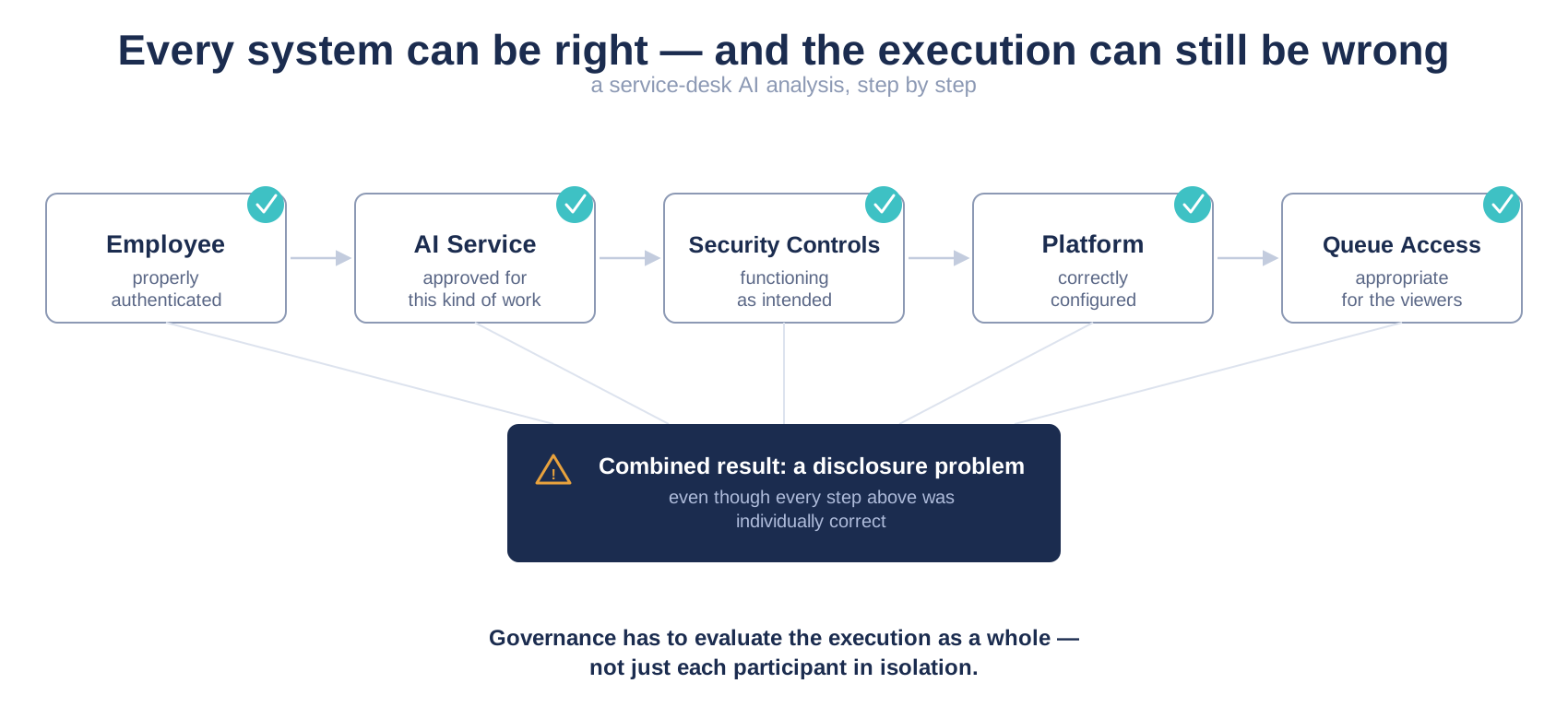
Each participant can make the right decision within its own scope while the combined execution still produces an outcome the enterprise should not allow.
That is the gap orchestration alone does not close.
The question is no longer simply where the AI result should go next. The enterprise has to determine whether that result, in its current form and under the conditions that now apply, is permitted to go there at all.
Governing Context Is Larger Than Any One Participant
That example creates an interesting architectural problem.
One possible response would be to give every participant all of the context that might matter to governance: who initiated the work, what authority they have, which policies apply, what information is restricted, what earlier decisions were made, what destinations are permitted, and what conditions must be satisfied before the work continues. That would be a poor solution.
An external model analyzing ticket content may need the tickets and the instructions required to perform the analysis. It probably does not need the employee's full authority context, the enterprise's internal approval logic, every security determination associated with the execution, or unrelated information about who may ultimately receive the result. Some of that information may itself be sensitive.
The execution therefore may need to preserve more governing context than any individual participant should possess.
Context continuity does not require context disclosure.
The enterprise needs relevant authority, policy, restrictions, validation requirements, and prior decisions to remain connected to the work. But that does not mean every model, agent, application, or external service needs to receive them.
A participant should receive what it needs — and is permitted — to perform its task. The broader execution still needs enough governing context to determine what may happen after that participant returns its result.
That separation becomes increasingly important as AI-enabled work crosses vendors, administrative domains, and trust boundaries. The more heterogeneous the environment becomes, the less reasonable it is to assume every participant will understand, preserve, or enforce the enterprise's entire governance model.
Control Has to Remain Active While the Work Is Underway
The problem becomes harder because the path through an AI-enabled execution may change while the work is happening.
A model may return a result that needs additional validation. A service may become unavailable. A policy or security condition may make the planned destination inappropriate. Another participant may become better suited to the task. A human decision may become necessary only after the execution reaches a point that was not apparent at the beginning.
Orchestration can help respond to those changes by selecting another participant or moving the work along a different path. But the governing conditions should not disappear because the technical path changed.
If a restriction applied before the work was rerouted, it may still apply afterward. If particular authority is required, substituting another agent should not make that requirement vanish. If a result must be validated before it can affect a business action, changing the model that produced it should not remove that condition.
The participants can change and the path can change. The conditions governing the execution still have to matter.
That is why governance cannot operate only when a workflow is designed, when an AI system is approved, or after the execution is complete. It has to remain active while the work can still be affected.
A Finding Becomes Control When It Changes What Happens Next
Enterprises are becoming increasingly good at observing AI systems. They can capture logs, traces, model outputs, security signals, evaluation scores, validation results, and other evidence about what happened.
Those functions are essential. An enterprise cannot govern work it cannot see. But seeing a problem and controlling it are different things.
Return to the service-desk example. Suppose the enterprise detects that the AI-generated conclusion would reveal information to people who are not authorized to receive it.
Detecting that condition is useful. Recording it is useful. Alerting someone may also be useful. But if the same result is still written into the same queue, the finding did not control the execution.
Control begins when the finding can change what happens next.
Perhaps the restricted information can be removed while the rest of the analysis continues. Perhaps the full result should go only to an authorized recipient. Perhaps the destination should change. Perhaps the disclosure decision requires someone with appropriate authority. Stopping everything is only one possible response.
Governed execution should be able to proceed, change, wait, escalate, or stop according to what the governing conditions require.
This is also why validation matters differently once AI becomes part of execution. An AI result can be accurate, coherent, and useful without automatically being suitable to propagate downstream. The relevant question is not simply whether the AI produced a good answer. It is whether the enterprise should allow that answer to affect what happens next.
Validation becomes part of control when the execution has to respond to it.
Distributed Authority Still Has to Produce a Governed Outcome
None of this requires the enterprise to move every authority into one system.
Security should continue to make security determinations. Identity systems should continue to establish identity and access. Business functions should retain their policies and decision rights. People with delegated authority should continue to make the judgments assigned to them. The goal is not consolidation. It is continuity.
When one of those authorities makes a determination that matters to an execution, that determination has to remain capable of affecting the work even if the work has moved into another system or changed direction.
That is a different architectural responsibility from simply connecting systems together.
Integration can move information. Orchestration can coordinate participants. Observability can show what happened. Specialized controls can make decisions within their own domains.
Governed execution has to keep those decisions relevant to the same work strongly enough to affect whether and how that work continues.
The Architecture Has to Follow the Execution
Once we look at the problem this way, the architectural requirement becomes clearer.
The enterprise does not need one system to become the source of every policy, authority, security decision, validation requirement, or human judgment. It needs a control responsibility that can operate across those domains while the execution is underway.
That control responsibility has to remain with the work rather than being tied to whichever model, agent, application, or platform happened to start it. Governing conditions that still matter must remain relevant as participants change. Findings from different enterprise authorities need to become consequential to the execution. And the enterprise needs enough continuity to understand later not only what happened, but why the work was permitted to proceed as it did.
We call that architectural category the AI Hyper-Control Plane™.
An AI Hyper-Control Plane is not simply another orchestrator. Orchestration remains important because work still has to be coordinated. But coordination and control answer different questions.
Orchestration asks: what happens next?
Governed execution also asks: given everything that now applies, what is permitted to happen next?
Consequential AI-enabled work increasingly requires both.