
The first three articles in this series approached the same shift from different directions. Once AI begins affecting what happens next, it becomes part of enterprise execution. Orchestration can coordinate that work, but coordination alone does not determine whether the work is still permitted to proceed. And once control has to remain active while execution is underway, the organization has to make business ownership, technical operation, policy, authority, and accountability work together.
The architectural responsibility that emerges from those conditions is what we have called an AI Hyper-Control Plane. The white paper behind this series defines four requirements for that architecture: cross-domain operation, runtime participation, consequential control, and accountable execution.
BuffAIt is an AI Hyper-Control Plane built on an architecture for governed AI execution. Certain aspects of that architecture are the subject of a pending U.S. patent application.
This final article looks at what those requirements mean in practice. The point is not to inventory BuffAIt features. It is to show the control behaviors required when the object being governed is an execution that can change while it is underway.
This article describes the control responsibilities BuffAIt is designed to address, rather than the implementation mechanisms used to address them.
Start With the Execution, Not the AI
Most AI platforms naturally begin with the participant performing the work. Which model should answer this request? Which agent should perform the task? Which tool should it invoke? Which service should handle the next step?
Those are necessary questions. BuffAIt starts one level higher: what is the enterprise trying to accomplish, and what has to remain true while that work is being carried out?
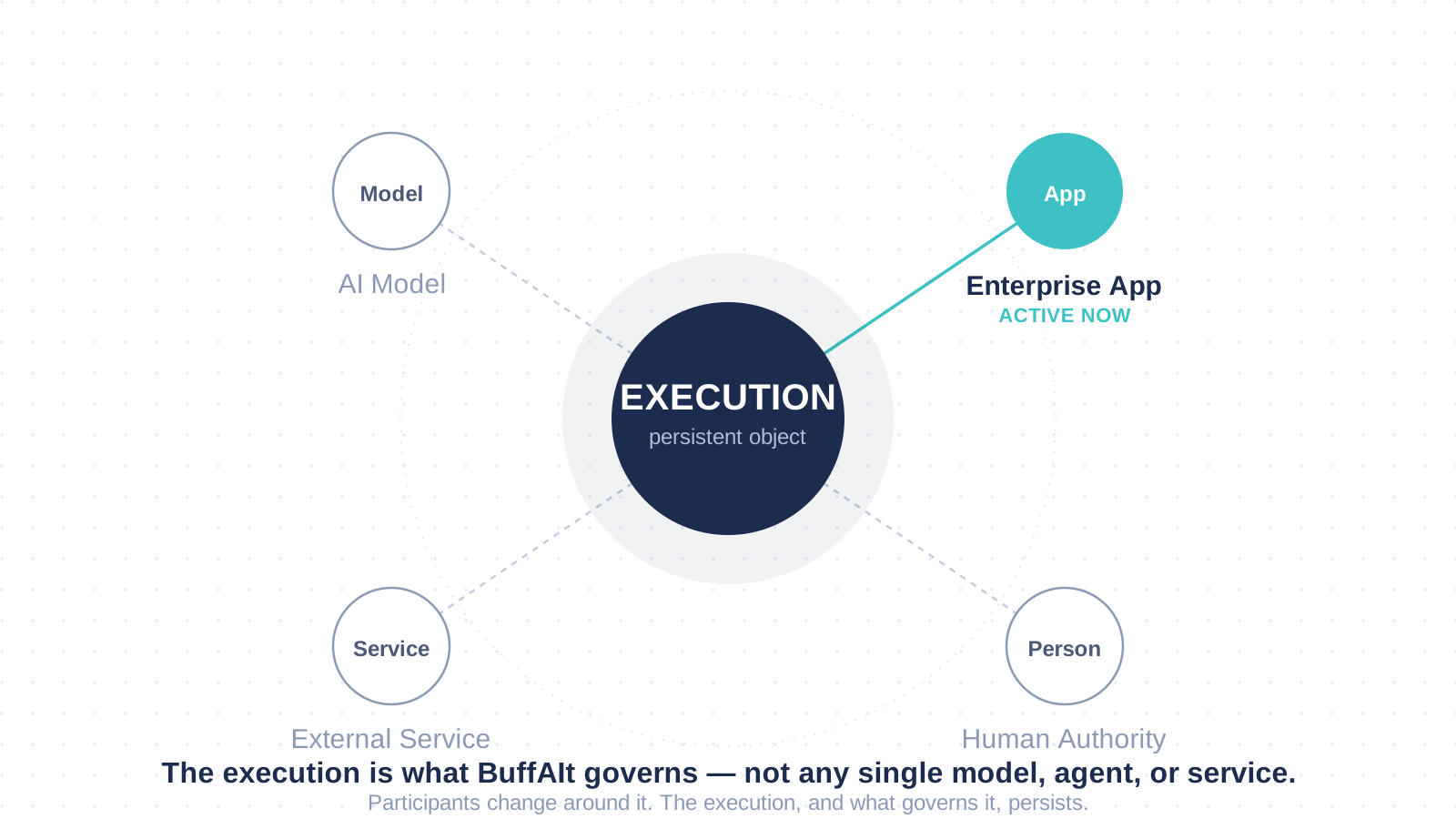
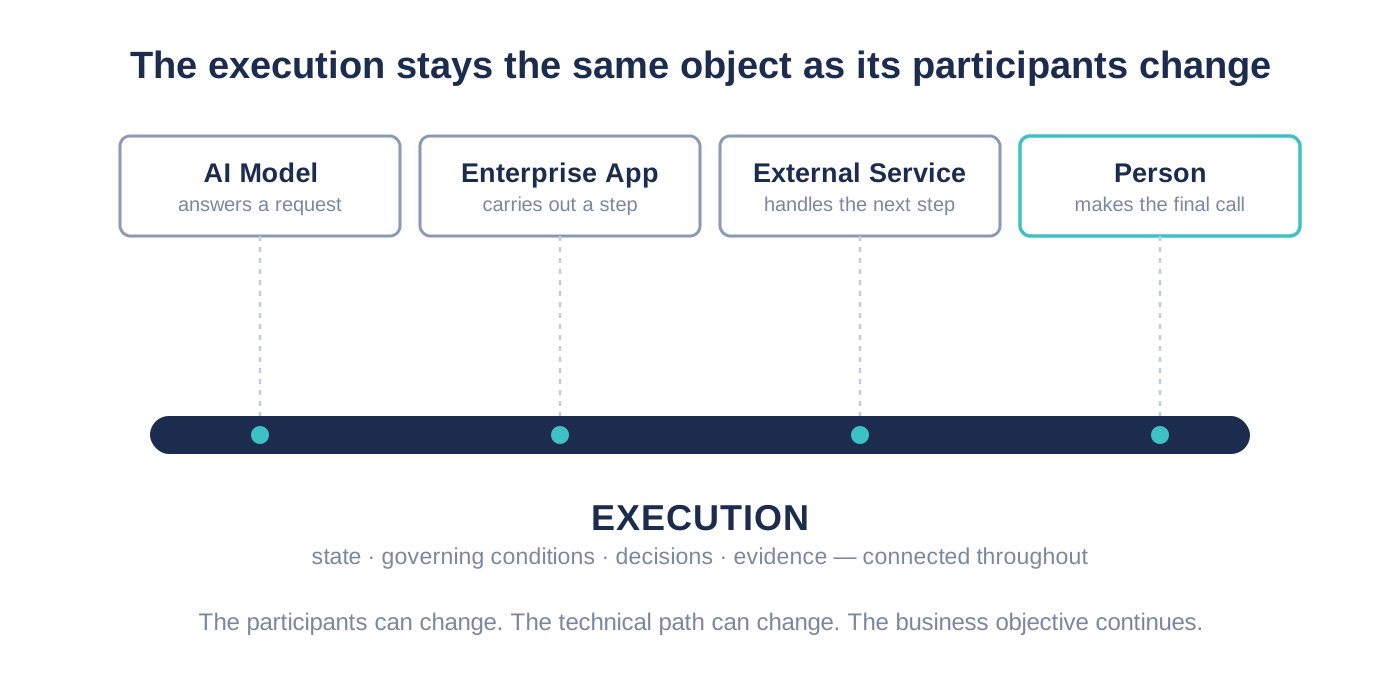
A single business execution may involve a model for one task, an enterprise application for another, an external service after that, and eventually a person with authority to make a decision. The participants can change. The technical path can change. Some participants may not be AI systems at all. The business objective, however, continues.
In BuffAIt, the execution — not any individual model, agent, application, or service — remains the persistent object being governed. Its current state, governing conditions, relevant decisions, and evidence remain connected as the work progresses. That gives the enterprise something stable to govern even when the systems performing the work are changing.
It also makes the distinction developed in the second article in this series concrete. Orchestration still matters because work has to move. Governed execution has to answer another question alongside it: given what is now known, what is permitted to happen next?
Authority Is Contextual — and the Context Keeps Changing
Enterprise identity systems answer an essential question: who or what is acting? Once work is underway, the enterprise also has to determine what that identity is authorized to do for this execution, under the conditions that apply now.
Those conditions can change. A transaction may cross an approval threshold. New information may introduce a restriction. The purpose, destination, or consequence of the work may change. The identity can remain exactly the same while the authority required for the next action changes.
BuffAIt keeps the identity involved in the work connected to the authority, scope, and constraints relevant to that particular execution. As conditions evolve, that context remains relevant to determining whether the authority already present is sufficient for what the work is now attempting to do.
Authentication may still be valid. The more important runtime question is: is this identity authorized for what is about to happen now?
Authority therefore cannot be treated only as a decision made when execution begins. It has to remain consequential as the context of the work changes.
Governance Has to Produce a Decision
Keeping governing context connected to the execution matters only if the architecture can act on it. At different points in the work, the relevant conditions may include authority, enterprise policy, security determinations, prior approvals, validation results, restrictions, and other requirements.
A policy may require additional approval above a threshold. A security rule may restrict where certain information can be sent. A business rule may require validation before a commitment becomes final. Those rules do not become execution control simply because they exist. They become control when the current execution can be evaluated against them and the resulting determination can change what happens next.
Within BuffAIt, governing conditions can affect whether the execution proceeds as planned, changes course, waits for another condition or decision, or does not proceed. Governed execution therefore needs more than a binary choice between allow and block. It has to be able to proceed, change, wait, or stop according to the conditions that apply at that point in the work.
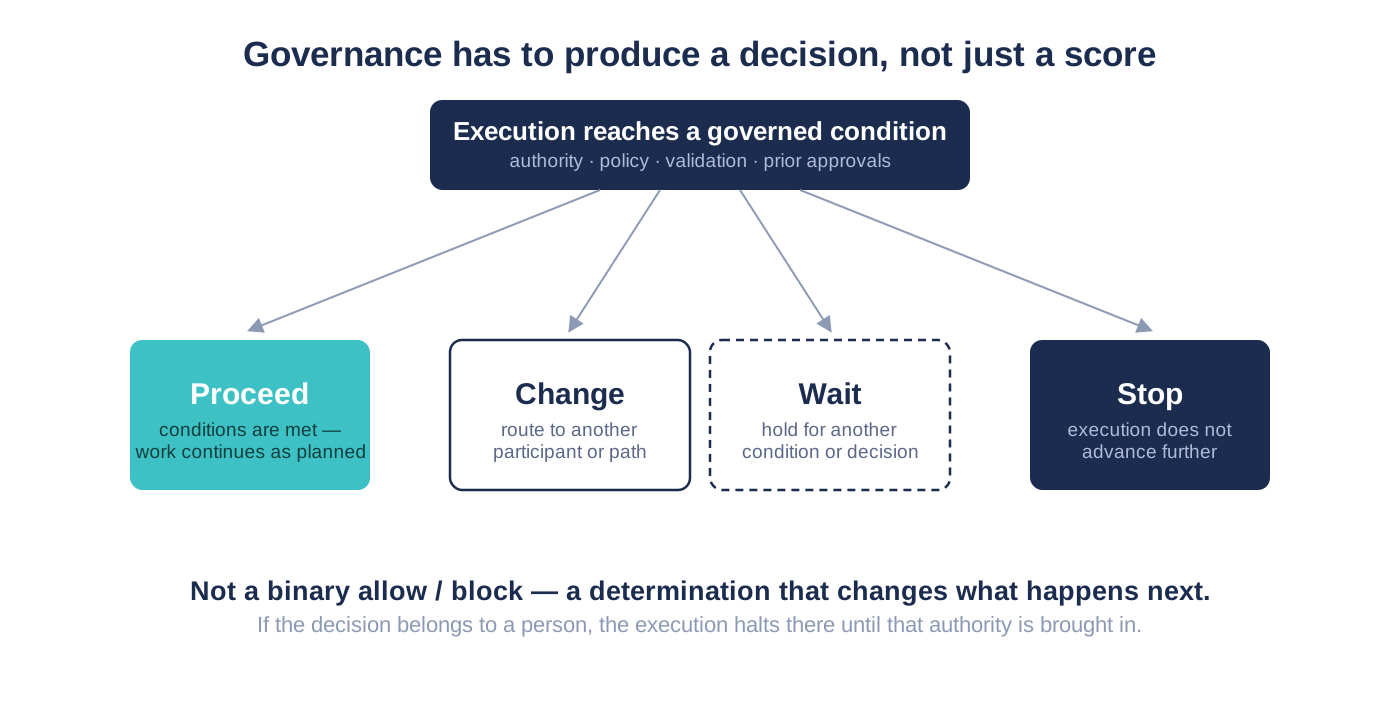
Human judgment fits naturally into that model. If the execution reaches a decision the enterprise has reserved for a person, BuffAIt can prevent the work from advancing past that point and bring the appropriate authority into the execution. The technology does not acquire that person's authority. It makes the need for that authority operational.
Producing an Answer Does Not Earn the Right to Advance
AI introduces another control problem: a task can complete successfully and still produce a result that should not become the next enterprise action.
The model returned an answer. The service responded. The agent completed its assigned task. None of that necessarily means the result should propagate.
BuffAIt validates relevant outputs before downstream work is allowed to depend on them, so that determination can become part of execution control rather than simply another score, alert, or piece of telemetry.
If an enterprise detects that an answer is incomplete but allows it to proceed exactly as though nothing happened, the finding did not govern the execution. Control begins when that finding changes what happens next. An acceptable result may allow the work to continue. A partial result may require more information. A failed result may lead to another attempt or another participant. Uncertainty may require human authority. Some conditions may require the execution to stop.
The particular form of validation can vary with the work. The architectural principle is simpler: advancement is earned rather than assumed.
Governed Execution Has to Be Able to Change Its Mind
Traditional automation often begins with a defined path: establish the workflow, approve it, and then execute it. AI makes that assumption harder to sustain because new information can appear, a participant can fail, validation can reveal that more work is required, a policy or authority condition can make the planned route inappropriate, or a human decision can alter what should happen next.
When governed conditions make the original path inappropriate, BuffAIt can alter how the execution proceeds. Work may be rerouted, additional validation or evidence may become necessary, or human review may have to enter before the execution continues.
The important point is that adaptation does not erase governance. A restriction does not disappear because another agent performs the task. Required authority does not vanish because another service becomes involved. A validation requirement does not cease to matter because the execution took an unexpected turn.
The path can change without losing the conditions that still govern the work.
That is different from simply giving an AI system more freedom to improvise. The objective is controlled adaptability: allowing execution to respond to changing circumstances while preserving the enterprise's ability to determine what remains permissible.
The Workflow Should Not Be the Only Thing Allowed to Say "Stop"
Sometimes the concern is not a single output, but the behavior of the execution itself. Repeated validation failures, governance denials, stalled progression, or other conditions may indicate that continuing normally no longer makes sense.
If intervention is possible only through the workflow already running, the safeguard remains dependent on the thing it may need to interrupt. BuffAIt enables defined governance or safety conditions to interrupt or alter execution independently of the normal task path.
When defined conditions require intervention, that supervisory path can affect whether and how the execution continues — interrupting normal advancement, changing course, escalating the matter, ending the execution, or requiring another condition to be satisfied before work resumes.
The point is not that every unusual event should stop the work. It is that a material safety or governance condition needs a way to become consequential even when the ordinary task path would otherwise continue.
Control Has to Survive System Boundaries
A governed execution may move among internal models, vendor agents, AI embedded in enterprise applications, external services, APIs, workflow systems, data platforms, and conventional applications. Those participants may come from different vendors and operate across different technical and trust boundaries.
The enterprise still needs the governing context of the execution to remain intact, but that does not mean every participant should receive all of it.
An external AI service may need the information required to perform its assigned task without needing the requester's broader authority context, internal policy logic, prior approval history, or other information governing the execution. Some of that context may itself be sensitive. The execution may therefore need to retain more governing context than any individual participant should possess.
This is where a principle introduced earlier in this series becomes especially important: context continuity does not require context disclosure.
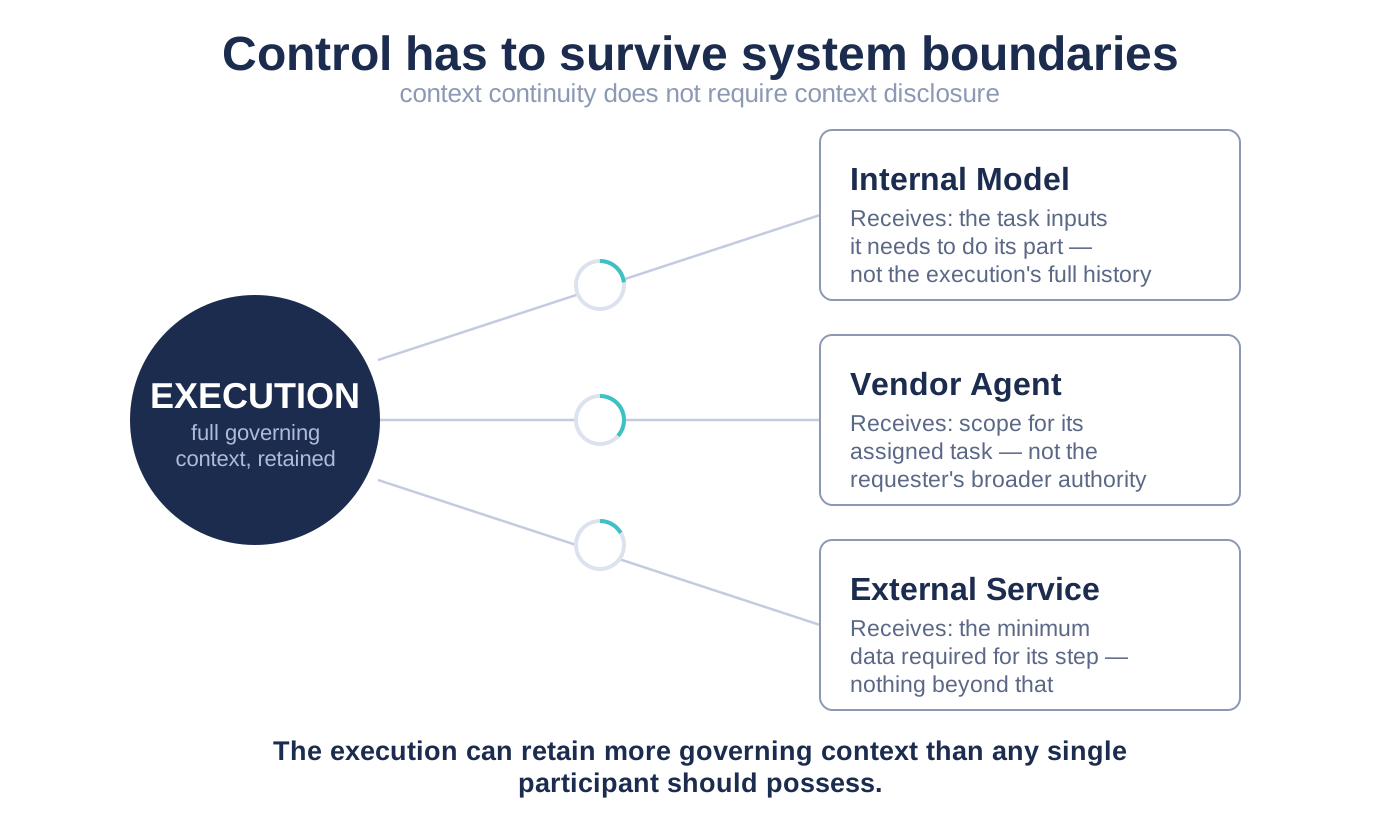
BuffAIt maintains the governing context required by the broader execution without requiring every participating system to receive that full context. An individual participant can receive what it needs and is permitted to use while the execution retains the information required to govern what happens afterward.
The important outcome is continuity: the work can cross systems without losing the context needed to determine what is permitted to happen next.
Accountability Has to Survive a Changing Path
Eventually, every execution reaches an outcome. Then the enterprise has to answer a different question: why did it happen that way?
That can be difficult when the work has crossed multiple systems. The original request may exist in one place, a model result in another, a security determination somewhere else, and a human approval in yet another application. Meanwhile, the execution may have changed paths or encountered new governing conditions.
Every system involved can preserve an accurate local record and still leave the enterprise without a coherent explanation of the execution as a whole. BuffAIt keeps relevant governing decisions, validation results, path changes, human decisions, interventions, participant interactions, and evidence associated with the execution so the governed path can later be reconstructed.
The important concept is execution reconstruction. AI is probabilistic, so repeating a model interaction later does not necessarily recreate the same response. Accountability therefore cannot depend on rerunning the work and expecting history to reproduce itself.
The enterprise instead needs to be able to reconstruct the governed path: what the execution was trying to accomplish, which conditions applied, which participants were involved, what determinations occurred, how the path changed, and why the resulting action was ultimately permitted or prevented.
The record of what happened should remain connected to the record of why it was allowed to happen.
The Responsibilities Have to Operate Together
The AI Hyper-Control Plane framework identifies five responsibilities that have to remain active within governed AI execution: identity and authority, policy, validation and safety, human judgment, and evidence. BuffAIt does not treat them as independent checkpoints.
A change in context can alter the authority required. That can change which policy conditions matter. A policy determination can require additional validation. Validation can change the execution path or require human judgment. That decision can change what the execution is permitted to do next. Each of those events contributes to the evidence explaining the final outcome.
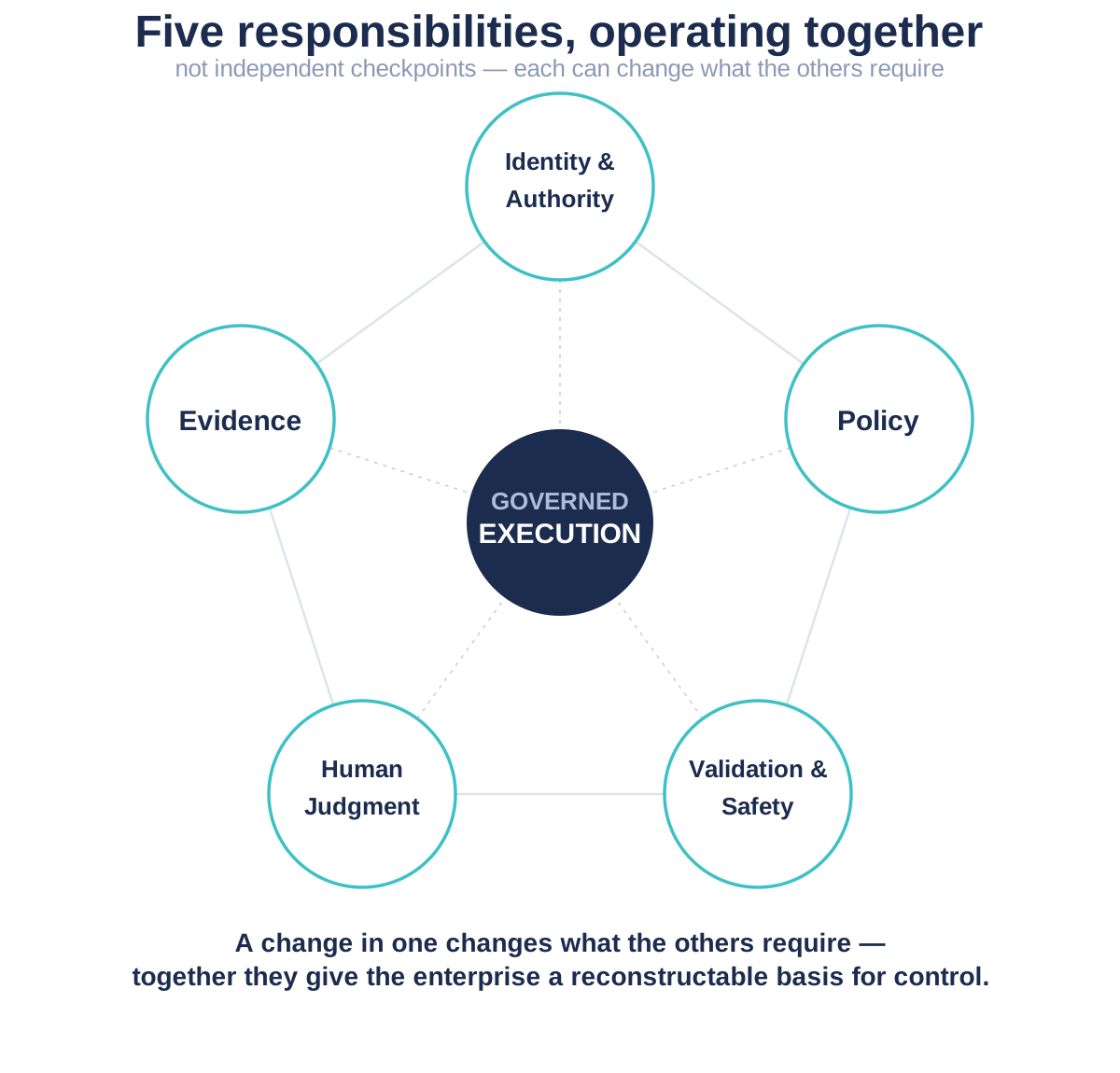
This is what makes the architecture more than a collection of controls. The execution can cross heterogeneous systems, governance remains active while the work is underway, relevant findings and decisions can change what happens next, and the enterprise retains a reconstructable basis for accountability.
Those are the architectural behaviors behind cross-domain operation, runtime participation, consequential control, and accountable execution. None is sufficient on its own. They have to operate together around the same evolving work.
From Architecture to Enterprise Control
An AI Hyper-Control Plane is not defined by the presence of one mechanism. It is defined by the ability to maintain control across an execution as that execution changes.
BuffAIt is built around that responsibility. Its purpose is not to replace the AI platforms, enterprise applications, identity systems, security systems, workflow technologies, data platforms, or organizational authorities an enterprise already relies on. Those systems and authorities continue to perform the roles assigned to them.
BuffAIt keeps their relevant determinations connected to the same evolving execution strongly enough to affect what happens next.
That matters because the technical environment will not remain fixed. New models and agents will enter the enterprise. Business platforms will add their own AI. Specialized services will appear and disappear. The technical path through enterprise work will continue to change.
The enterprise needs to accommodate that change without losing identity and authority, policy, validation and safety, human judgment, and evidence across the work those systems collectively perform.
That is the responsibility the AI Hyper-Control Plane defines. And that is the problem BuffAIt solves.