
The first two articles in this series focused on the technology problem. Once AI becomes part of enterprise execution, governing the AI system is no longer enough. The work itself has to remain governed as it moves across systems, conditions change, and different authorities become relevant.
That sounds like an architectural challenge, and it is. But architecture only gets us part of the way.
Once governance can actually affect an execution while it is underway, the enterprise has to answer organizational questions that technology cannot answer on its own. Who owns the business outcome? Who decides which policies apply? Who has authority to accept an exception? When should a person become involved? Who operates the execution-control architecture that makes those decisions effective? And what evidence does the organization need in order to remain accountable for the result?
Those responsibilities may appropriately remain with different teams. The business may own the outcome. Technology may operate the execution-control layer. Security, risk, legal, finance, data, and other functions may retain authority over the conditions that fall within their domains. People with delegated authority may still own particular decisions.
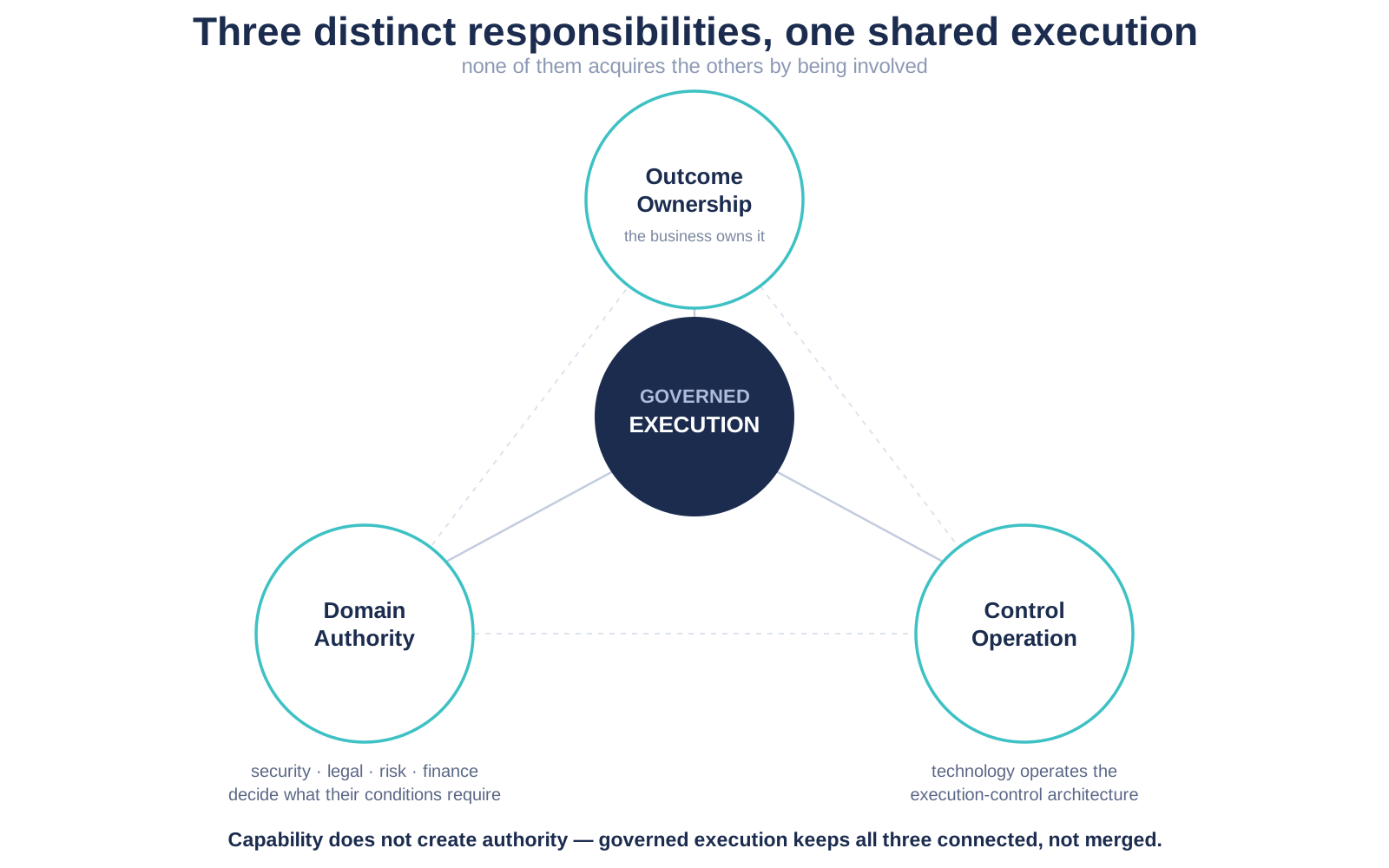
Governed AI execution does not require those responsibilities to move into one organization. It requires them to work together while the execution is still happening.
That is why AI execution control changes the operating model, not just the architecture.
The Question Is Not Who "Owns AI"
Enterprises have spent a surprising amount of time asking who should own AI.
Should it sit with technology? Data? A central AI office? Individual business units? Risk? Some combination of them?
There may be good reasons to establish ownership for AI platforms, standards, infrastructure, or strategy. Governed execution introduces a different question because one team cannot realistically own all of the decisions that may govern a business outcome.
Imagine an AI-enabled process that touches customer data, uses an external model, makes a recommendation with financial implications, and eventually requires approval from a business executive. Technology may operate the systems involved, but it does not therefore acquire authority over customer-data policy, financial approval, risk acceptance, or the business decision itself.
The same distinction applies in the other direction. A business leader may own the outcome without needing to operate the technical mechanisms that enforce security policy, validate AI outputs, preserve execution state, or prevent work from advancing when a governing condition is not satisfied.
Ownership of the outcome, operation of the control architecture, and authority over the decisions governing the work are different responsibilities.
The operating model has to make those distinctions explicit. Otherwise, an organization can end up in an uncomfortable middle ground where everyone assumes someone else is responsible for the execution as a whole. Each function may properly govern its own area, yet no one has established how those separate decisions become effective as the same work moves across them.
Governance Has to Become Operational
Most enterprises are not short on policy. They already have rules governing security, data use, financial authority, privacy, procurement, compliance, access, exceptions, human approvals, and many other aspects of business activity. AI may create some new policy requirements, but a large part of the challenge is more basic: policies that already exist have to become meaningful inside AI-enabled execution.
There is a difference between writing a policy and making it operational.
A policy may say that certain information cannot be sent to a particular class of external service. It may say that a certain decision requires a person with designated authority. It may require validation before an action becomes final or specify the conditions under which an exception can be granted.
Those requirements can be perfectly clear on paper. Applying them while work is underway requires more precision. What information is relevant to the determination? When should the condition be evaluated? What happens if it is not satisfied? Can part of the work continue? Does the execution need a different path? Who is authorized to make an exception? What evidence must be preserved before the work moves forward?
Those are partly technical questions, but they begin with organizational decisions.
Security still decides what security policy requires. Legal still determines the legal requirements within its authority. Business functions still establish business rules and acceptable outcomes. Risk functions still define the conditions they are responsible for governing.
The execution-control architecture can evaluate conditions, enforce a determination, change the path of the work, request additional information, or bring in the appropriate decision-maker. But it should not invent the enterprise policy it is enforcing.
That separation matters. Otherwise, implementation choices quietly become policy decisions.
The Technology Does Not Become the Authority
This may be the most important organizational distinction in governed execution: a system can be responsible for making a decision effective without having the authority to make the underlying decision.
We already accept this distinction in many areas of enterprise technology. An identity platform can enforce an access decision without deciding the company's employment policy. A payment system can enforce transaction limits without deciding the company's financial strategy. A workflow platform can route an approval without acquiring the approver's authority.
AI execution control should work the same way.
The technology may recognize that a required condition has not been satisfied. It may prevent the execution from advancing, apply a requirement for additional validation, route the work to an authorized person, or change the execution path after that person makes a decision.
None of those actions gives the technology authority to decide which risks the enterprise is willing to accept or which exceptions are appropriate.
That distinction becomes especially important as AI systems grow more capable. It would be easy to blur the line between an AI system that can reason about a decision and an organization that has actually authorized it to make that decision.
A model may be capable of assessing whether an exception seems reasonable. The enterprise may still reserve exception authority for a specific person. An AI system may be able to compare several courses of action. A business owner may still be accountable for choosing among them.
Capability does not create authority.
The operating model therefore has to define not only what the technology can do, but where organizational authority remains and how that authority enters the execution when it is needed.
Human Judgment Has to Enter in the Right Place
This changes how we should think about human oversight as well. "Human in the loop" can sound reassuring, but the presence of a person does not automatically create accountability. What matters is whether the right person enters at a point where their judgment is actually required, with the authority and context necessary to make the decision.
Some conditions can be resolved automatically. A defined policy requirement may be either satisfied or not. A validation mechanism may determine whether an output meets an established standard. A security system may make a determination within its existing authority.
Other situations involve judgment the enterprise has deliberately assigned to people: accepting risk, approving an exception, making a financial commitment, resolving material uncertainty, or choosing among business alternatives.
The goal is not to insert a person into every AI-enabled execution. It is to know when human authority is required and make that authority consequential to what happens next.
That requires organizational work before the technology can do its part. Decision rights need to be clear. Delegated authority needs to be understood. Exception paths need to be defined. The enterprise has to decide which judgments can be automated and which remain accountable human decisions.
The control architecture can then bring those decisions into the execution at the point they matter.
One Execution Can Cross Many Owners
A relatively ordinary business process shows why this gets complicated.
Consider a customer account that appears ready for activation. The contract has been signed. The customer exists in the CRM. Credit has been approved. Billing has been configured. An AI-enabled process is assembling the information and preparing the account to move forward.
During that work, the AI discovers a later contract amendment. The amendment changes the payment terms and the legal entity that will actually be billed.
Nothing about that discovery necessarily means the AI failed. Finding the amendment may be exactly what the AI was supposed to do. But the new information changes the context in which earlier decisions were made.
The existing credit approval may have been based on the original payment terms. The billing configuration may still point to the original legal entity. The employee who initiated the activation may not have authority to decide whether the earlier approval remains sufficient.
Now several organizational responsibilities become relevant to the same execution.
The business still owns the customer outcome. Finance or credit may hold authority over whether the existing approval remains valid. Contract or legal requirements may govern which entity can be billed. A human decision may be necessary if an exception is required. Technology has to make sure the account does not simply advance as though nothing changed.
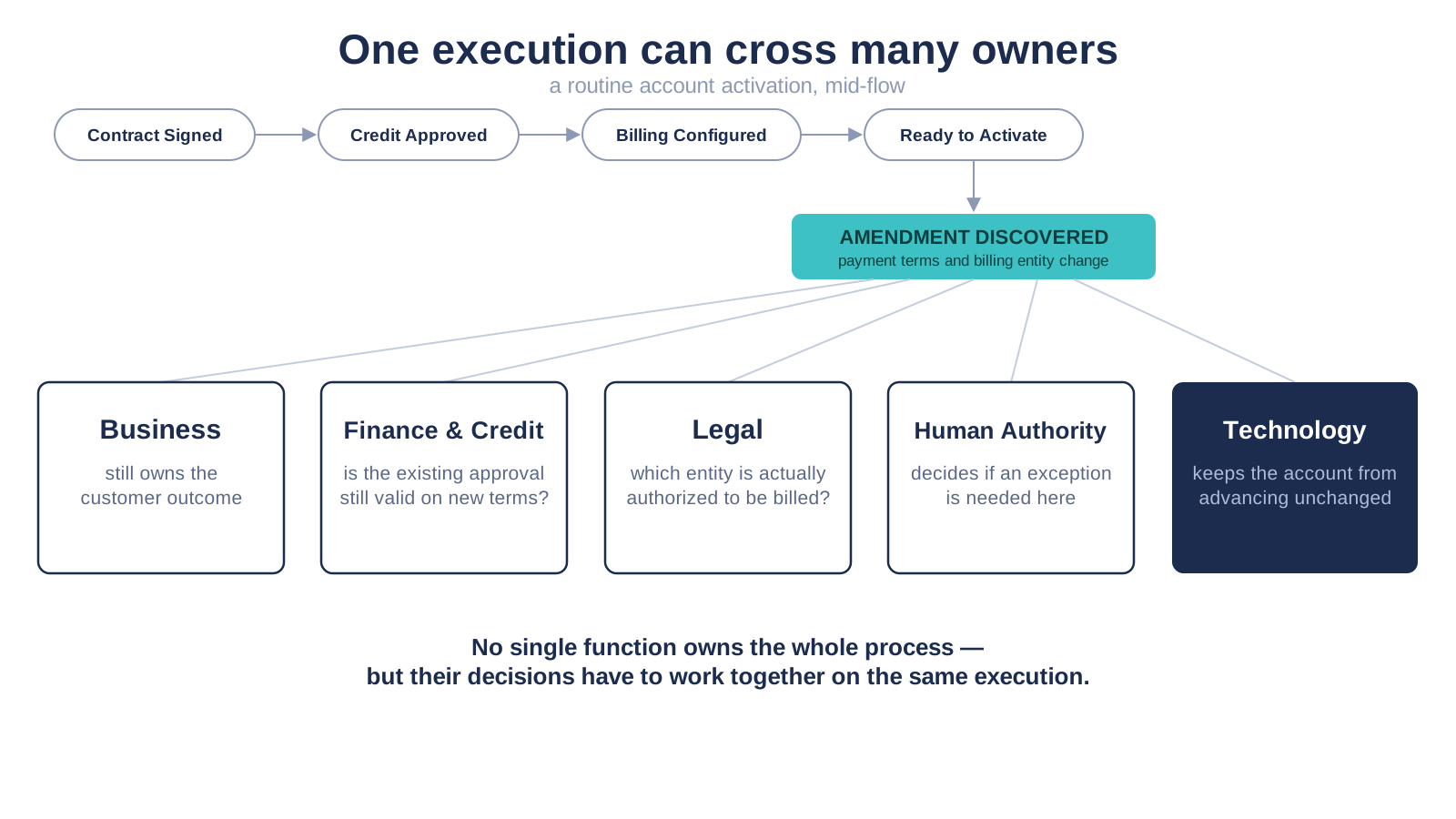
No one of those functions needs to take ownership of the whole process. Their decisions do, however, have to work together.
The amendment changes what policy conditions matter. Those conditions change what needs to be validated. The validation result may determine whether another authority has to enter. That decision, in turn, changes what the execution is allowed to do next.
This is what makes governed execution an operating-model issue. The architecture can keep those decisions connected to the work, but the organization still has to know who owns each decision and what it means.
Accountability Requires More Than Local Records
The same distributed structure creates another organizational responsibility: evidence.
Most systems participating in an execution already produce records. An identity system records authentication. A security platform records its findings. An AI system may record prompts and outputs. A workflow platform records task progression. A person may approve an exception somewhere else.
Each record can be accurate and still leave the enterprise without a coherent explanation of the outcome.
Accountability usually asks a broader question than "what did this system do?" A business owner may need to know why an action was allowed to proceed. Risk may need to understand how an exception was resolved. Security may need evidence that a restriction remained in effect. An auditor may need to know which authority made a particular decision.
Those questions concern the same execution.
The organization therefore has to decide what evidence is important enough to preserve and how the relevant decisions, conditions, interventions, and changes remain connected to the work they affected.
More logging is not necessarily the answer. The useful record is the one that lets the enterprise reconstruct how the outcome became permissible.
That is an organizational choice as much as a technical one. The enterprise has to decide what it expects to be able to explain later.
A New Enterprise Operating Responsibility
Governed AI execution does not require a new department that absorbs business ownership, technology, security, risk, legal, data, finance, and human decision authority. Doing that would recreate the same centralization problem the architecture is trying to avoid.
What it does require is an explicit operating responsibility for keeping those distributed authorities connected to the execution strongly enough for their decisions to matter.
The business can continue to own the outcome. Technology can operate the execution-control architecture. Specialized functions can retain authority over the policies and conditions within their domains. Authorized people can continue to own decisions that require human judgment.
But the enterprise must assign responsibility for ensuring that the operating model works as a whole: policies can become operational, decision rights are understood, the appropriate authority can enter when conditions change, evidence remains coherent, and execution does not quietly proceed simply because the technology is able to continue.
That responsibility cannot remain implicit as AI becomes more deeply involved in enterprise work.
The question is therefore no longer simply who owns the AI. It is whether the enterprise has an operating model capable of governing AI-enabled execution while the work is underway.
That is what turns governed execution from an architectural idea into an enterprise operating responsibility.